
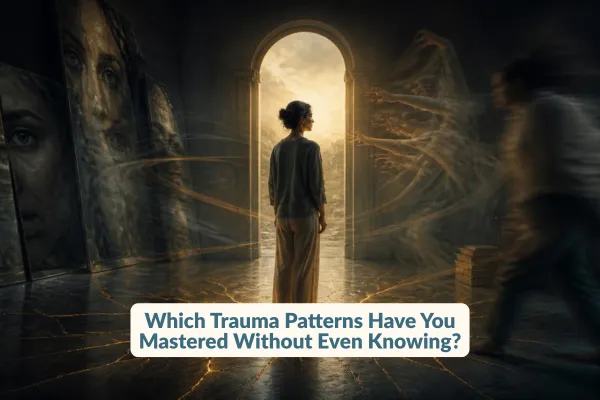
Which Trauma Patterns Have You Mastered Without Even Knowing?
Here is something rarely said about trauma: it makes you very, very good at certain things.
Not good in the way we usually mean — not consciously practiced, not deliberately developed. Good in the way survival sharpens you. Good in the way that a body under repeated threat learns, without being taught, exactly what to do to stay safe.
The patterns you developed are not flaws. They are mastery. The problem is that most people don't know they have them. And the patterns that once protected you are now running the show — quietly cracking the foundation of the life you're trying to build.
Consider the person who can read a room in seconds. Who knows before anyone speaks whether something is wrong, who is angry, where the tension lives. That is not a personality quirk. That is hypervigilance — the nervous system of a child who had to know, early and accurately, what kind of day it was going to be. In adulthood, it looks like intuition. It feels like awareness. And it is exhausting in a way that person can't always explain, because they never stop scanning.
Consider the person who cannot stop helping. Who says yes when they mean no. Who keeps everyone around them comfortable and regulated and never names what they need, because somewhere very early, keeping others comfortable was how they stayed safe. That is fawning — a survival response dressed as generosity.
Consider the person who works without stopping. Who fills every hour, who cannot tolerate stillness, who describes themselves as driven. Busyness as armor. Motion as a way of staying ahead of whatever is waiting in the quiet.
These are learned. These are adaptive. At one point in your life, they were the right response to an untenable situation. The tragedy is not that you developed them. The tragedy is that they have become so automatic, so woven into how you function, that you experience them as simply who you are.
This is where the quiet cracking lives — not in the obvious breaking points, but in the invisible competencies. The ones that look like strength. The ones other people admire. The ones you have built an entire identity around, not realizing they are fracture lines.
Naming them is not an act of weakness. It is the most precise form of self-knowledge available to you. To look at your most automatic responses and ask: where did this come from, and is it still serving me? That question is the beginning of something.
Because here is what becomes possible when you stop mistaking your coping for your character: you get to choose. Not perfectly, not all at once, not without difficulty — but genuinely, with increasing freedom, you get to decide what you carry forward and what you set down.
The patterns you've mastered kept you here. That matters. And what comes next — the slow, necessary work of seeing them clearly — is how you stop merely surviving and start becoming unbreakably alive.
--
If you got to the end of that and thought yeah, that's me - I built something for you.
I'm Elizabeth Power. Vanderbilt Masters, Fulbright Scholar, eight years teaching psychiatry at Georgetown — and a PTSD diagnosis in 1980 and MPD/DID about a decade later. The Masters happened while it was all still running. So when you say your feelings are too big for the room, I'm not translating that from a textbook.
If you've tried the books, the apps, and the workshop HR paid for, and you're still bracing every feeling with nothing practical for the stress of work (and life), that's the gap I built this to fill.
The Stress-Bending Resilience Course. Eight modules, eighteen trainings, none of them long. You can do it in the gaps in your week, which is honestly how I built it, because that's how most of us live.
And for $197, you have it for a lifetime. Go have a look here:
https://thetraumainformedacademy.xperiencify.io/elastic/elastic/



Email our Admin:
©Copyright 2025 EPower & Associates, Inc. All Rights Reserved.
Privacy Policy | Terms of Use
Featured On...
