

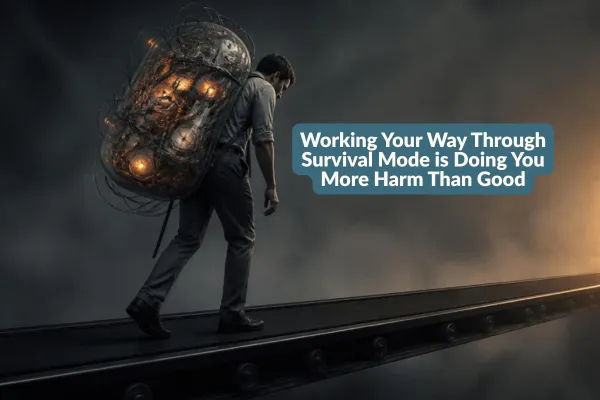
Working Your Way Through Survival Mode is Doing You More Harm Than Good
There's a version of strength that looks like never stopping. Like staying functional no matter what. Like handling it — whatever "it" happens to be — because someone has to, because you always have, because stopping feels more dangerous than continuing.
That version of strength has a cost most people don't see coming. Not because it breaks you loudly, but because it breaks you quietly.
The quiet cracking is the part nobody talks about. It doesn't announce itself. It shows up as the flatness that settles in after months of just getting through. The way joy starts requiring more effort than it used to. The numbness that you mistake for stability, the short fuse you chalk up to stress, the creeping sense that you are present in your life but not quite in it. You’re still moving. You’re still producing. And somewhere underneath all of that forward motion, something essential in you is fracturing along lines you haven't stopped long enough to see.
Survival mode is meant to be temporary. The human nervous system can handle acute stress with remarkable grace — it's designed for it. What it's not designed for is the chronic, unrelenting state of high alert that modern life, grief, trauma, and relentless pressure have turned into a permanent address.
When the threat never fully passes, the system never fully rests. And a system that never rests doesn't only wear down — it begins to reorganize around the emergency. Functioning becomes the only mode. Rest starts to feel irresponsible. Stopping starts to feel like collapse.
Here is the difficult truth: pushing through is sometimes the very thing preventing you from healing.
Not because effort is wrong. But because survival mode is not a through-line — it is a detour. It's the body and mind doing whatever it takes to stay upright when upright is all that's possible. Staying in it past its purpose means mistaking a detour for a destination.
The way out isn't more pushing. It's the terrifying, necessary act of letting yourself crack.
This is where unbreakably alive becomes possible — not on the other side of hardness, but inside the breaking itself. There is an old Japanese practice of repairing broken pottery with gold, filling the fractures rather than hiding them, making the mended piece more beautiful and more durable than the original. The cracks aren’t erased. They become the most honest part of what something is.
You don't become unbreakably alive by never breaking. You become unbreakably alive by learning that the breaking doesn’t finish you. That what you are isn’t diminished by what you've survived. That the places you've fractured quietly, the places you've held together with nothing but will — those places, met with care, can become the strongest lines in your whole structure.
Survival mode kept you here. It did its job.
But here is where you get to decide what comes next — not another layer of coping, not another strategy for endurance, but an actual return to yourself. Slower. More honest. And more alive than simply surviving ever allowed you to be.
--
I'm Elizabeth Power. Vanderbilt Masters, Fulbright Scholar, eight years teaching psychiatry at Georgetown — and a PTSD diagnosis in 1980 and MPD/DID about a decade later. The Masters happened while it was all still running. So when you say your feelings are too big for the room, I'm not translating that from a textbook.
If you've tried the books, the apps, and the workshop HR paid for, and you're still bracing every feeling with nothing practical for the stress of work (and life), that's the gap I built this to fill.
The Stress-Bending Resilience Course. Eight modules, eighteen trainings, none of them long. You can do it in the gaps in your week, which is honestly how I built it, because that's how most of us live.
And for $197, you have it for a lifetime. Go have a look here:
https://thetraumainformedacademy.xperiencify.io/elastic/elastic/




Email our Admin:
©Copyright 2025 EPower & Associates, Inc. All Rights Reserved.
Privacy Policy | Terms of Use
Featured On...
