
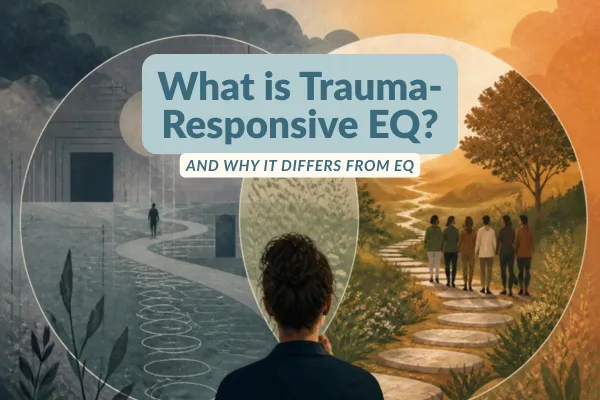
What is Trauma-Responsive EQ - and Why it Differs from EQ
TR (Trauma Responsive) has the T-word in it--trauma. The belief most of us harbor because of what we have heard all our lives is that “trauma” is some form of maltreatment. People who experience it are called “victims” or “survivors.” There are “perpetrators” and “abusers” galore. Sometimes the people who are traumatized become this--”hurt people hurt people,” right?
The R word--Responsive--means we respond to the impact of those events that are “traumatic,” so overwhelming they make us think we might die, lose our mind, or be badly injured.
We take the model called “trauma informed” and act on it, not from a place still centered in pathology, maltreatment, or mental disorder, but from the present: the recent pandemic, natural disasters, accidents of all sorts, medical crises, and yes, maltreatment. Being trauma informed is not the goal, responding from that place, or a place of hope, is. That’s why the R.
EQ has the “E” word--Emotional. The feelings we have, how we label them, our mastery of the skill of increasing and decreasing their intensity and duration, learning the difference between feelings and facts.
Q for “Quotient” is the shorthand for “Intelligence.” It includes the thought patterns we have, the meaning we make, the policies we set, the rules we have about what we think will get us where (and more).
When you put on the TR glasses, including the additional skills that are common to EQ, the power of all your intelligences increases.
The difference in the two models ? Perspective, practice, and partners.
Perspective. In the face of repeating patterns, the inability to do something, EQ’s perspective: "Why can't you do this? You must not be _______ enough (fill in the blank)" which implies deficit. It’s based on the past and how it’s filtered.
TR-EQ? It’s curious, seeks information and possibilities. In organizations, it asks about how the organizational culture formed, and what beliefs it might reflect. It considers what might be adjusted and how based on the individual and collective strengths and skills. In individuals, pretty much the same thing is required from a different point of view.Practice. Another difference is the amount of effort each requires in the now. Maintaining the present EQ takes no additional effort. Adapting and expanding it to be TR does. It requires practice and attention, much like an athlete developing specific muscles for the task.
Partners. While both require relationships, or partnering, it’s for different reasons. In both, relationships are the ground for action.
In TR, it’s a given that the current state reflects outdated patterns. The partnering is with people who have smoothed or mastered more of their pasts than you have--you partner with those whose healing is a little further along. Athletes, musicians, and people progress when they partner with someone whose skill is greater than their own. They do it so they can learn. They pick their mentors, coaches, and consultants with care.
My name is Elizabeth Power. I finished a Master's from Vanderbilt, then became a Fulbright Scholar in trauma-informed care, where I then spent eight years teaching psychiatry as an adjunct at Georgetown Medical Center. What I don't usually put at the front of that is that I was also diagnosed with PTSD in 1980, the same year the mental health field decided it existed as a diagnosis and MPD/DID about a decade later (the field still isn’t sure about it sometimes!). The Masters happened while it was all still part of my life.
I'm not listing that to impress you. I'm listing it because most people assume those two halves of a life can't sit in the same person, and they can. And you can still be functional and effective while resolving them.
So when you say your feelings are too big for the room, or that you keep blowing up relationships you actually wanted, or that you move through your day feeling marked - I'm not translating that from a textbook.
That's thirty years and six continents' worth of what I do, built into eight modules. Eighteen trainings, none of them long.
And for $197, you have it for a lifetime.
So, if you have tried books, apps, and/or a workshop your HR department paid for, and you are still bracing every feeling with no practical tool to help you deal with the stress of work (and life), this course was made for you.
Go have a look here:
https://thetraumainformedacademy.xperiencify.io/elastic/elastic/


Email our Admin:
©Copyright 2025 EPower & Associates, Inc. All Rights Reserved.
Privacy Policy | Terms of Use
Featured On...
